
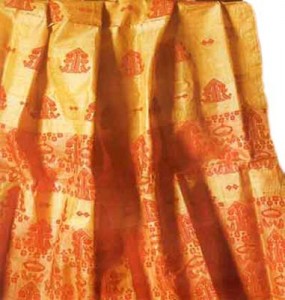
Assam has got a suitable climate and environment for practicing sericulture. There are three varieties of Silk Worms found in Assam, namely – 1. Muga Silk Worms, whose cocoon can be reeled, 2. Eri Silk Worms, whose cocoon can’t be reeled and 3. Paat or Mulberry Silk Worms.
1. Muga Silk
Muga Silk is the most prestigious silk of Assam. This unique silk is mostly found in Assam only. The reason is – Muga Silk Worms cannot survive in any climate other than that of Assam or North East. The scientific name of Muga Silk Worm is “Anthera Assama”. Assamese people are very very proud of this silk. The colour of this silk is “Golden”, that gives it the unique identity. Assam is the largest producer of this “Golden Silk” in the World.
Muga Silk Worms are rared in almost all districts of Brahmaputra valley. According to Assam Government records, about 2625 hectares of land are utilised for production of Muga Silk, in Assam. About 30,000 Assamese households are related with Muga Silk production. There are 15 Muga Silk Reeling units in Assam. Sericulture department of Assam Agricultural University, Jorhat is doing various research and extension activities for development of Muga Silk Industry. Central Silk Board, India is also engaged in the development of Muga Silk.
2. Eri Silk
Eri Silk Worm rearing is a tradition of Assam from time immemorial. Eri silk worms feeds on castor leaves and the cocoon can’t be reeled. So it needs spinning! The rearing, spinning and weaving of Eri Silk is carried out in almost all the districts of Assam. The total area under the cultivation of food plants of Eri Silk Worm is the state counts for about 2993 hectares. At present, the state has 21 Eri Silk Spinning training centres. There is also a Sup Silk Mill in Assam, located at Jagiroad. About 1.28 lakh families of Assam are engaged in the rearing and production of Muga Silk.
3. Paat or Mulberry Silk
Paat or Mulberry Silk also occupies an important place in Assam’s Sericulture. About, 40,000 families of the state are engaged in the production of Mulberry Silk. The total are under the cultivation of food plants for the mulberry silkworms is about 2300 hectares. In Assam, the Mulberry Silk Worm culture is practised on a large scale in the districts of Upper Assam. Lakhimpur, Sibsagar, Dibrugarh and Jorhat districts are the important producers of Mulberry Silk. In order to produce more and more mulberry silkworm seeds, the State Sericulture Department has also organised a systematic “Seed Organisation Programme”. A Cold Storage plant has also been set up in the Kamrup District of Assam for the preservation of Mulberry Silk Worm Seeds.
Although, silk is produced in almost every district of Assam, Sualkuchi is the main silk weaving centre of Assam. Situated in the kamrup district, Sualkuchi is also called as the “Manchester of the East”. Weavers in Sualkuchi produces amazing fabrics of Muga Silk as well as Mulberry Silk.
Recently Government of Assam has also introduced the Oak Tassar in Assam. Hill areas of Assam are suitable for cultivation of Oak Tassar, as Oak trees grows in abundance there. In the two hill districts of Assam – Karbi Anglong and North Cachar, five Tassar Centres have been set up for the production of seeds and rearing of Oak Tassar.
I am hs pass, am I able to study sericulture? If yes, then how can I apply for this?
I m interested in sericulture department of assam .If any job application is publish please send me latest apply form please
I m intersted sericulture depertment…..So send me a letest apply information
We have to submit project on sericultuure, is is very disappointmenting that sericulture dept do not have their website. We have to face a lot of difficulties in gathering information…
It is very disappointing that Assam state sericulture Department does not have any web site. Seeking information on Assam silk becomes very difficult. Please wake up (Dept guys…).
I am preparing a project report investigating into the causes for decline in demands of silk in loocal markets. How far will thesestep is helpfull to you all?
We are interested to develop computer software on Application of computers in sericulture, kindly suggest as to how we could cooperate with each other in this
project of developing the software.
Dr.Mrs.Sushma Joiya
National President
9864227424
I am looking for information on “whether the mulberry trees are likely to be affected by the temperature and humidity changes due to climate change and how the impacts of climate can be overcome”
I am a textile design consultant who has been working with weaving coops in Assam trying to develop new products for the domestic market and export in Muga and Eri. I hope to return soon.
I think this is a very informative website.
Thank you.
Barbara Arlen
Barbara Arlen Design & Associates
New York City
b.arlen@mac.com